
The manufacturer of window opening machine reduction motors shares the working principle of the reducer.
Its function is to use gear size and speed converters to reduce the motor's (motor) revolutions to the desired speed. It is a mechanism for obtaining greater torque. Currently, the application range of reducers in the transmission of power and motion is quite broad. Below, the window opener reducer motor manufacturer shares the working principle of the reducer.
Release time:
2022-03-17 14:26
The reducer is actually a kinetic energy transmission mechanism that does not generate kinetic energy itself. Its function is to use the size of the wheels and speed converters to reduce the motor's (motor) speed to the required speed. It is a mechanism for obtaining greater torque. Currently, the application range of reducers in the transmission of kinetic energy and motion is quite broad. The following textWindow openerReduction motorManufacturers share the working principle of reducers.
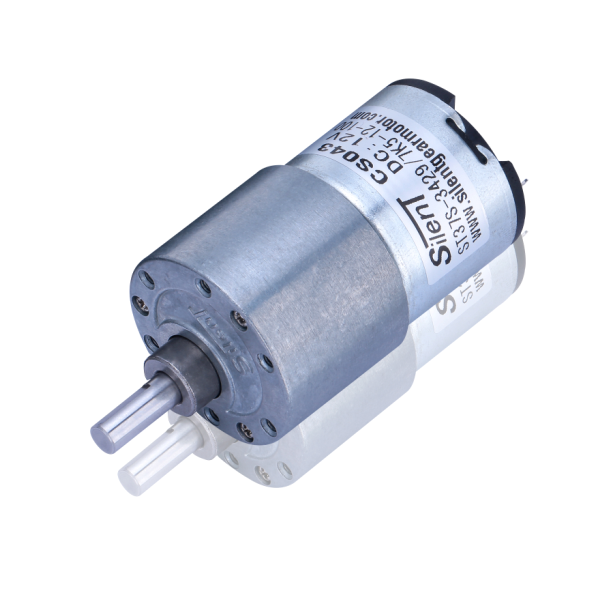
Some people have questions, can't we just adjust the motor's speed directly? The window opener reduction motor manufacturer believes it is not that simple. The reducer is a mechanism that experiences greater torque when changing speed. The motor is directly connected to the equipment. When the equipment is working, the load on the motor is very large, which can cause significant damage to the motor, but this is different after passing through the reducer. For example, with a reduction ratio of 100, the load on the motor during machine operation is only 1%, so it is not significant. In addition, the window opener reduction motor manufacturer believes that if the reducer breaks, only the wheel needs to be replaced, which is much cheaper than replacing the motor, as a broken motor is almost useless.
Currently, the application range of reducers in the transmission of kinetic energy and motion is quite broad. For example, wheel reducers can be seen in almost all types of mechanical transmission systems. The principles of transportation vehicles such as ships, cars, locomotives, heavy construction equipment, and bicycles are similar to those of reducers. From processing tools and automatic production equipment used in the mechanical industry to common household appliances and watches in daily life, the application of reducers can be seen in precise angle transmission, from high-power transmission work to small loads. In industrial applications, reducers have the functions of reducing speed and increasing torque. Therefore, they are widely used in speed and torque conversion devices. For example, the elevators we use every day utilize a device called a worm reducer.
Window opener reduction motorManufacturers discuss the role of reducers:
1) Reduce speed while increasing output torque. The torque output is calculated based on the motor output multiplied by the reduction ratio, but it must not exceed the rated torque of the reducer.
2) Reduce load inertia while reducing speed; the reduction in inertia is proportional to the square of the reduction ratio. You will find that ordinary motors have inertia values.
Reducers are relatively precise machines used to reduce speed and increase torque. They come in various types, models, and Applications. Reducers can be classified into wheel reducers, worm reducers, and planetary wheel reducers based on the type of transmission. They can be divided into single-stage and multi-stage reducers based on the transmission supply. Based on wheel shape, they can be classified into cylindrical wheel reducers, conical wheel reducers, and conical-cylindrical wheel reducers. Based on the arrangement form of the transmission, they can be divided into spread type, shunt type, and coaxial reducers.
Window opener reduction motorManufacturers share their working principles.
Reducers are generally used in low-speed, high-torque transmission devices, combined with motors. The kinetic energy from internal combustion engines or other high-speed operations is input to the reducer through a small-toothed wheel meshing with a large wheel on the output shaft to achieve speed reduction. Ordinary reducers also have several pairs of wheels with the same principle to achieve the desired speed reduction effect, where the tooth ratio of the large and small wheels is the transmission ratio. Distinction
Window opener reduction motor manufacturer: The reducer reduces the speed of the motor (motor) through mechanical transmission, while the purpose of the frequency converter is to adjust the speed of the motor (motor) by changing the AC frequency. By using a frequency converter, energy-saving goals can be achieved when reducing the motor speed.
Related News
What is the difference between brushless reduction motors and brushed reduction motors?
Brushless DC Motor (BLDC) and Brushed DC Motor have some significant differences in structure, working principle, performance, and other aspects. Here are their main differences:
How to assess the noise level and vibration characteristics of a screw-type window opener motor?
When selecting a screw-type window opener motor, its noise level and vibration characteristics are two crucial factors that directly affect the user experience and the stability of the equipment. So, how should we evaluate these two aspects?
In the field of construction, screw-type window openers are important devices for achieving automated window opening and closing, and their performance and stability are crucial. Especially in some harsh environmental conditions, such as high humidity and dusty places, the protection level of the motor becomes a key factor in ensuring the normal operation of the window opener.
What are the common faults of screw-type window opener motors?
The screw-type window opener motor may experience some common faults during long-term use. Below are some typical fault phenomena and their possible causes.
Introduction to Micro DC Gear Motors
Introduction to Micro DC Gear Motors Micro DC gear motors are a miniaturized motor system, typically consisting of a DC motor and a gearbox. Here are some related introductions to micro DC gear motors: DC Motor Section: Working Principle: The DC motor generates current by moving a conductive coil in a magnetic field, thus producing electromagnetic force to drive the motor's rotation. Structure: Micro DC motors usually adopt a separate structure, including an armature (rotating part) and an electromagnet (stator part). Types: Common types of DC motors include brushed DC motors and brushless DC motors. Brushed DC motors use brushes to connect to the armature, while brushless DC motors control current through an electronic speed controller, eliminating the need for brushes. Gearbox Section: Function: The gearbox is used to slow down the motor's output speed while increasing torque. This is crucial for applications requiring higher torque and lower speeds, such as robotic arms and camera gimbals. Structure: Gearboxes typically consist of gears that achieve the reduction ratio through different gear combinations. The reduction ratio is the ratio of input speed to output speed. Types: Common types of gearboxes include planetary gears, worm gears, and helical gears. Different types of gearboxes are suitable for different application scenarios. Applications: Micro DC gear motors are widely used in various fields, including consumer electronics (such as cameras and printers), medical devices, robotics, and automotive electronics. In these applications, micro DC gear motors are typically used to control precise movements, provide sufficient torque, and achieve efficient performance in limited spaces. Control and Drive: Micro DC gear motors usually require corresponding electronic speed controllers or controllers to precisely control rotation speed and direction. The control system can adjust the motor's output according to application needs, achieving precise position control and speed regulation. Performance Parameters: The performance parameters of micro DC gear motors include rated voltage, rated speed, rated torque, efficiency, etc. These parameters are crucial for selecting and designing motor systems. In summary, micro DC gear motors have been widely applied under the trends of miniaturization, precision, and efficiency, providing reliable driving force for many electric devices and systems.
Contact Information
Service Hotline:+86 0769-3901 7383
Mobile Phone: +86 180 0260 1103
Email: sunweihong@silentgear.cn
Factory Address: No. 15, Century Road, Baihao Industrial Zone, Houjie Town, Dongguan City, Guangdong Province
Quick Navigation
Online message
Contact Us

COPYRIGHT 2024 Dongguan Silent Industrial Co., Ltd.